Summary:
On November 26, 2026, Ontario announced new e-bike rules that take effect on May 1, 2027. From that date, an e-bike in Ontario stays licence-free only if it has an exposed bicycle-style frame, working pedals, a motor of no more than 500 watts and an assisted top speed of no more than 32 km/h. Motorcycle-style and scooter-style e-bikes will need a driver's licence, registration and insurance, with fines of up to $2,500 and impoundment for riders who break the rules. Nothing changes for riders here in Alberta.
Checked on November 26, 2026 against the Ontario government's backgrounder listed under Sources.
What Did Ontario Announce?
Ontario's Transportation Minister, Prabmeet Sarkaria, announced the new rules on Thursday, November 26, 2026. The province hadn't updated its e-bike rules since 2009, and the new regulation separates real e-bikes from electric vehicles that look and ride more like motorcycles or scooters.
E-bikes that meet the requirements keep riding like bicycles, with no driver's licence, plate or insurance. Anything that doesn't meet them can't be ridden as an e-bike in Ontario, even if it was sold or labelled as one.
Ontario's Two New E-Bike Classes
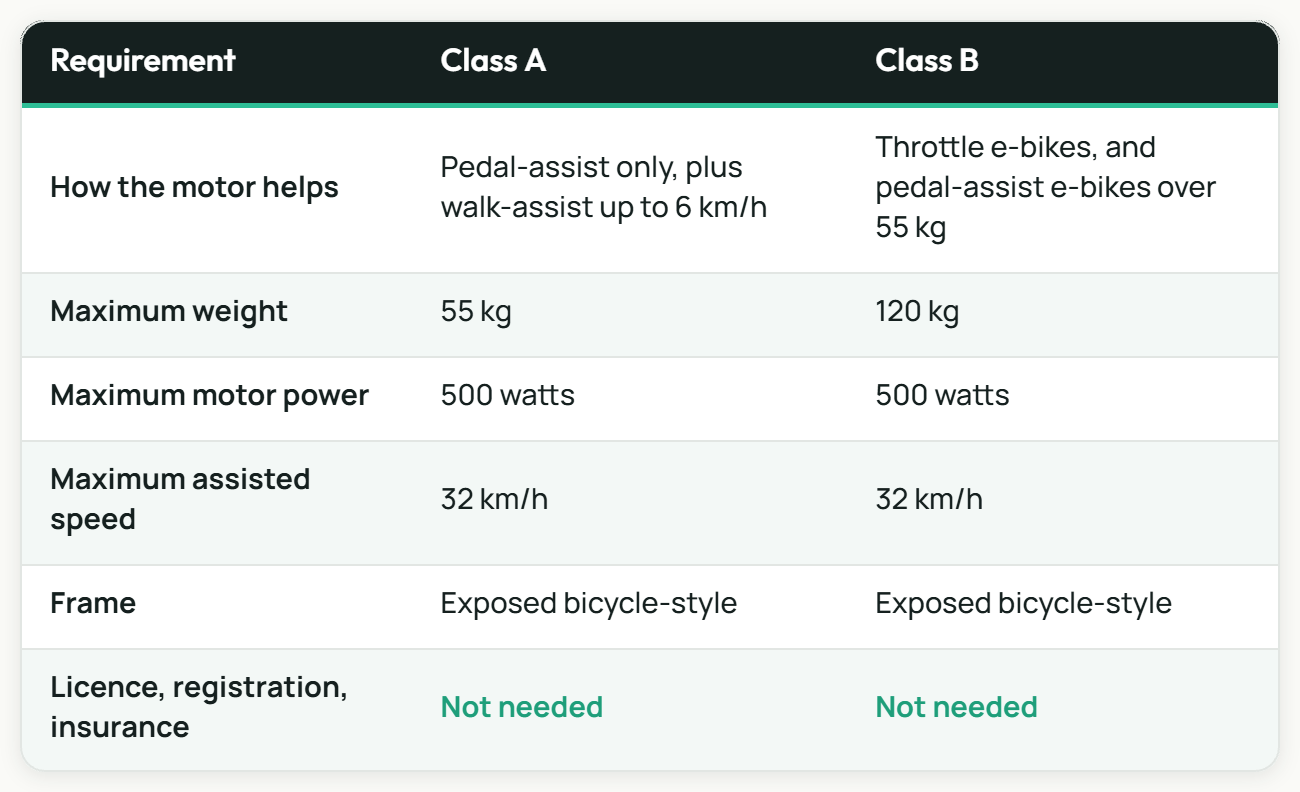
Good news for throttle fans: a throttle doesn't make an e-bike illegal in Ontario. It simply puts the bike in Class B.
What Every E-Bike in Ontario Must Have
On top of the class limits, every e-bike in Ontario will need:
- A bicycle-style riding position (recumbent designs count)
- Pedals or hand cranks that can really move the bike
- Two or three wheels, each at least 350 mm in diameter
- A motor and battery fastened securely to the bike
- Fully insulated and covered electrical terminals
- A dual braking system
- A white or amber front light, and a red rear light or red reflector
- A bell or horn
- White reflective material on the front wheel and red on the rear
E-bikes can't be modified to go past the power, speed or weight limits, and the pedals can't be removed or disabled. Bicycle-style, tricycle-style and recumbent e-bikes all qualify.
What Doesn't Count as an E-Bike?
Ontario lists motor scooter-style and motorcycle-style electric vehicles, electric dirt bikes, and anything without working pedals or hand cranks as vehicles that are not e-bikes. The same goes for anything over the 500-watt, 32 km/h or weight limits.
These are treated as motor vehicles. They can't be ridden where bicycles are allowed, and on the road they need a federal compliance label plus the licence, registration and insurance for a moped or motorcycle. Violations can bring fines of up to $2,500 and impoundment.
Riders and Passengers in Ontario
- Riders must be at least 16 and wear an approved helmet
- Riders follow the same rules of the road as cyclists
- Passengers of any age can ride if the e-bike has a proper passenger seat
- Children six and under must ride in a child passenger seat
- All passengers must wear an approved helmet
Does This Change Anything in Alberta?
No. Ontario's new rules apply only in Ontario. In Alberta, an e-bike (called a power bicycle) is still limited to a 500-watt motor and a top assisted speed of 32 km/h, and riders must wear an approved bicycle or motorcycle helmet. In Calgary, the minimum age for riding an e-bike is 12.
Calgary also has its own pathway bylaws, including a 20 km/h pathway speed limit. Our guide to electric bike laws in Calgary covers them in detail.
Taking Your E-Bike to Ontario?
If you're moving east or riding in Ontario after May 1, 2027, check your e-bike against Ontario's list before you go:
- Is the motor rated 500 watts or less?
- Is the assisted top speed 32 km/h or less?
- Does it have a bicycle-style frame and pedals that actually move the bike?
- How much does it weigh? Over 55 kg, or with a throttle, it's Class B, up to 120 kg.
- Does it have a front light, a rear red light or reflector, a bell and wheel reflectors?
- Has anything been modified to go faster or add power? Put it back to stock.
Not sure about your bike's motor rating? Stop by eBikes Calgary at Unit 106, 11127 15 Street NE, or contact us, and our team will go over your e-bike's specs with you.
Frequently Asked Questions
When do Ontario's new e-bike rules start?
May 1, 2027. Until then, Ontario's current e-bike rules still apply.
Are throttle e-bikes still legal in Ontario?
Yes. A throttle e-bike is Class B, as long as it has a bicycle-style frame, working pedals, a motor of 500 watts or less, an assisted speed of 32 km/h or less and a weight of 120 kg or less.
Do Ontario's new rules apply in Alberta?
No. Each province sets its own e-bike rules. Alberta's 500-watt and 32 km/h limits stay the same.
What is the fine in Ontario for riding a vehicle that isn't a legal e-bike?
Up to $2,500, and the vehicle can be impounded where that applies.
Sources
- Ontario Strengthening E-Bike Regulations to Protect Road Users (backgrounder), Ontario Newsroom
- Ontario Strengthening E-Bike Regulations to Protect Road Users (news release), Ontario Newsroom
- Using personal e-bikes and e-scooters in Calgary, City of Calgary
- Use of Highway and Rules of the Road Regulation, Alberta
General information, not legal advice. Check the official pages listed above before you ride.